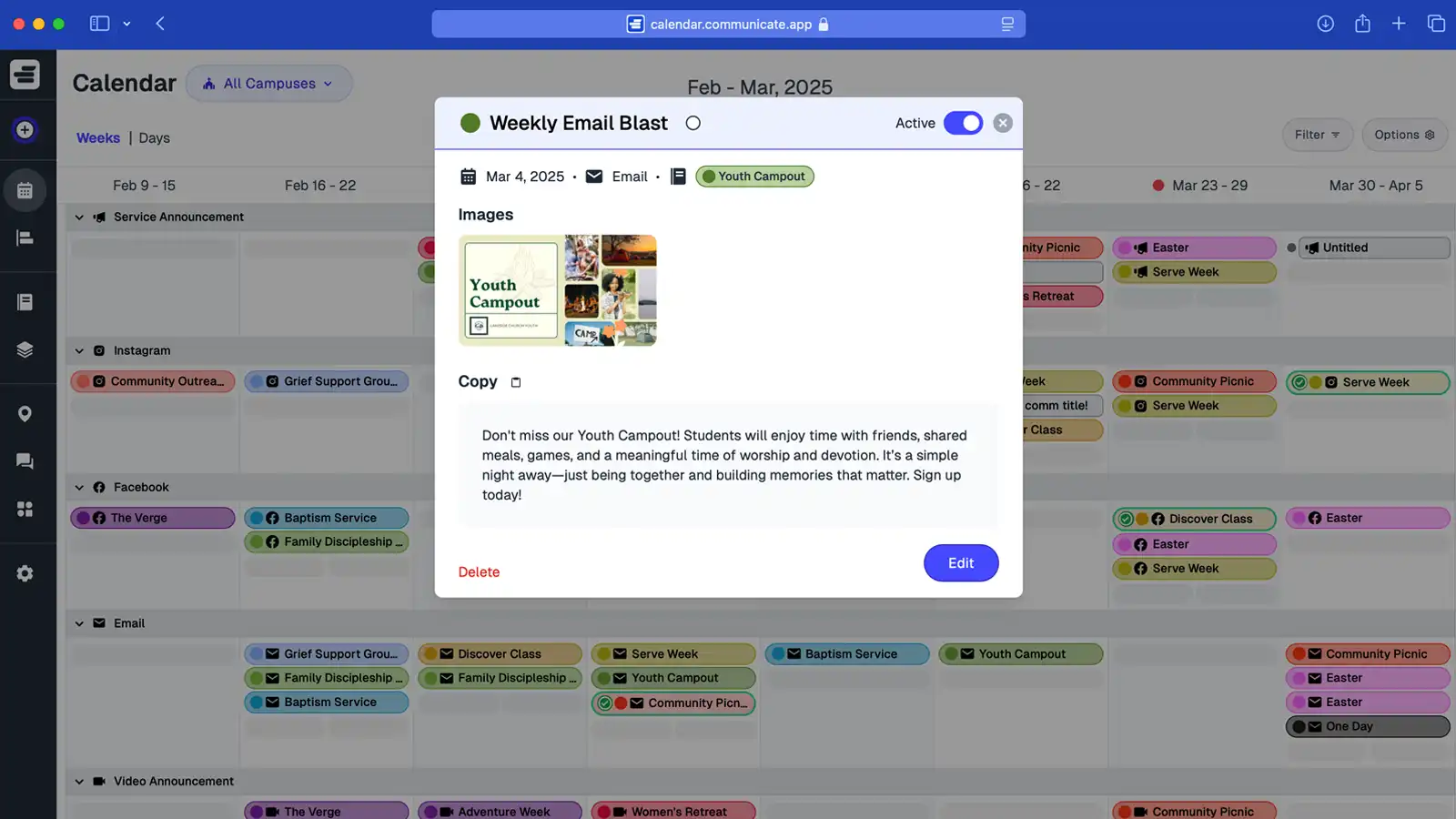
Church campaign planning software organizes campaigns in one shared calendar so sermon series, events, and announcements stay aligned. Teams can plan timelines, attach content, and coordinate channels with clear visibility. This approach prevents conflicts between ministries and ensures consistent messaging across all communication channels.
Short Answer: Church campaign planning software centralizes sermon series, events, and announcements in one shared calendar to prevent conflicts and ensure consistent messaging across ministries.
Church campaign planning is the process of organizing and coordinating messaging, events, and announcements around a central theme or goal across multiple ministries and channels. It involves aligning sermon series, seasonal events, ministry promotions, and communication timelines so that every message reinforces the same purpose and reaches the right audience at the right time. Effective campaign planning creates momentum, prevents message overlap, and helps churches communicate with clarity and consistency.
Learn why every campaign needs structure: Why Every Church Campaign Needs a Brief. For aligning campaigns with sermons and events, see How to Align Sermons, Events, and Announcements.
Church campaign planning is the process of organizing messaging, events, and announcements around a central theme across multiple ministries and channels.
See how Communicate’s church campaign planner helps ministries align sermon series, events, and seasonal campaigns on one shared calendar—so messaging stays clear, timelines stay in sync, and every channel works together.
Campaign planning software helps ministries align sermon series, events, and announcements in one shared calendar to coordinate messaging and timelines.
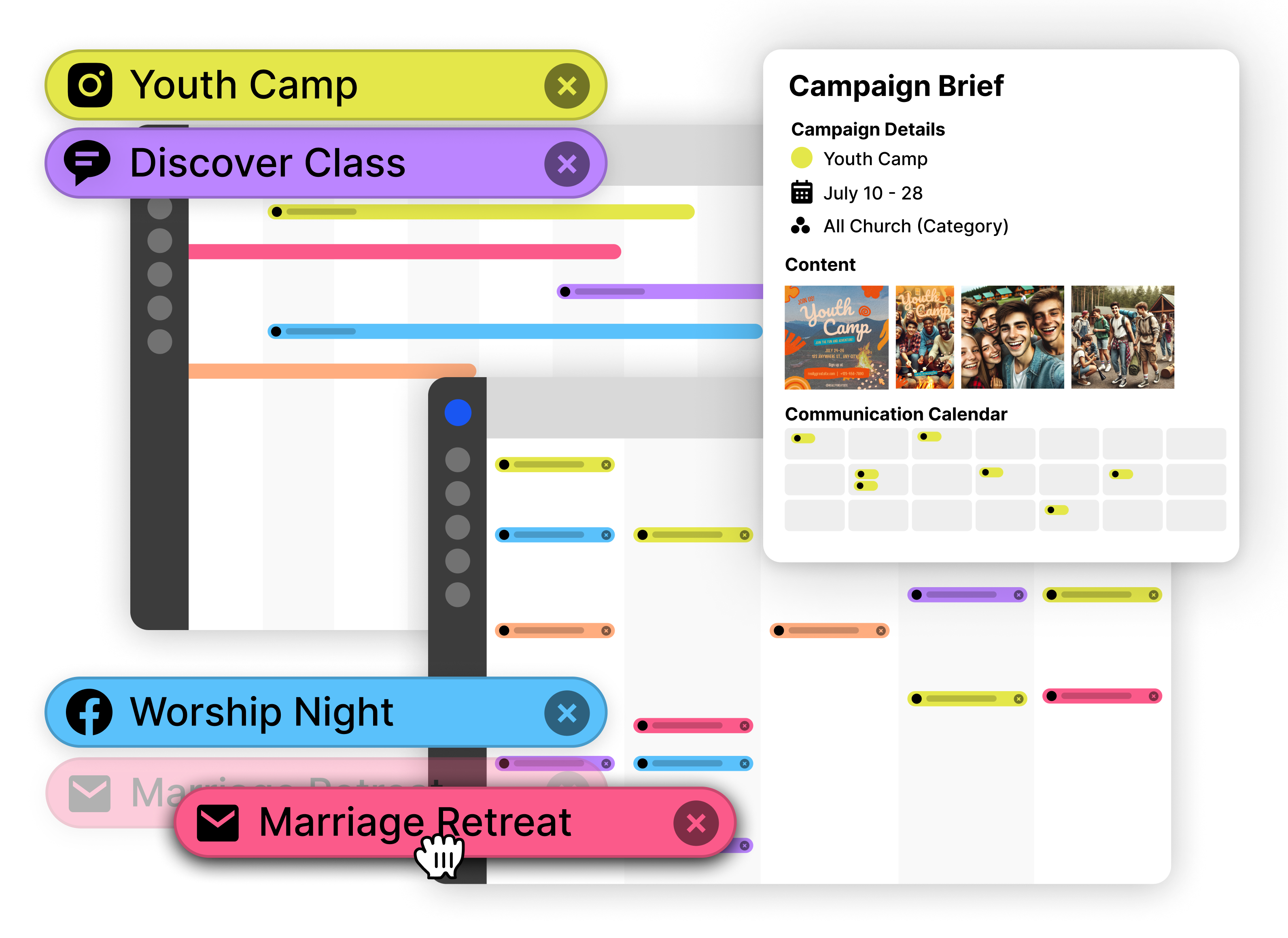
Without a church campaign planner, teams work in silos, timelines drift, and announcements pile up. It’s not a lack of effort—it’s the absence of one place to align every campaign.
Sermon series, seasonal events, and ministry promos each live in different spreadsheets. Without one campaign calendar, conflicts surface too late.
Every ministry wants visibility. Without coordinated campaign planning, competing messages overwhelm Sundays and weaken impact.
Campaign dates shift, but communication doesn’t follow. Without a shared campaign view, ministries scramble and members miss the message.
Church campaigns lose clarity when teams work in silos, timelines drift, and announcements pile up without a centralized planning system.
Communicate isn’t just another calendar—it’s the campaign hub that helps ministries plan sermon series, seasonal events, and announcements in one place. Align messaging, streamline timelines, and keep every ministry moving forward together.
Ditch scattered docs and siloed calendars. Use one church campaign planner to organize series, events, and ministry promotions with clarity.
Map out campaigns for Sundays, events, and ministry updates in one view. Avoid conflicting promotions and keep communication consistent everywhere.
From pastors to ministry directors, everyone sees the same plan. No surprises, no crossed wires—just campaigns executed with clarity and confidence.
Campaign planning software provides centralized planning, aligned messaging across ministries, and visibility for all leaders.
Communicate's church campaign planner centralizes planning for sermon series, seasonal events, and ministry promotions in one shared calendar.
Campaign planning works by organizing communications under campaigns, coordinating timelines, duplicating successful campaigns, and aligning multiple ministries.
Create campaigns for sermon series, seasonal events, or ministry initiatives. All related communications—emails, social posts, announcements—group under the campaign, making it easy to see the full scope of messaging.
Each campaign gets its own color, so you instantly see which communications belong together. When planning a 6-week sermon series, all related announcements and posts appear as one coordinated campaign.
See all campaign communications across dates and channels in one view. When a sermon series launch date shifts, update the campaign once and all related communications move together.
This prevents the chaos of updating individual communications across multiple channels. Campaign-level changes cascade to all related messages automatically.
Reuse successful campaigns for recurring events. Duplicate last year's Advent campaign, VBS promotion, or Easter series, then adjust dates and update copy as needed.
This saves hours of planning time while maintaining proven structures. Start with what worked before, customize for this year, and launch faster than building from scratch.
Link multiple ministries to a single campaign. When planning a church-wide initiative, worship, youth, kids, and outreach all contribute communications that reinforce the same campaign message.
The calendar shows all ministry contributions together, ensuring messaging stays consistent while each ministry adds their unique perspective and details.
See how churches use the campaign planner to coordinate major initiatives, seasonal events, and ministry promotions effectively.
Churches use campaign planning workflows to coordinate sermon series launches, seasonal events, and ministry promotions across multiple weeks and channels.
When launching a new sermon series, coordinated campaign planning ensures consistent messaging across all channels:
All communications stay grouped under the campaign, so your team sees the complete series plan. If dates change, update the campaign once and all communications adjust automatically.
Seasonal campaigns like Advent or Easter require coordination across multiple weeks and ministries:
The campaign view shows all seasonal communications together, making it easy to ensure messaging builds momentum and avoids conflicts with other ministry activities.
When launching new ministry initiatives or events, campaign planning prevents message overlap:
By viewing all campaigns in the calendar, you can see when ministry promotions compete for attention and adjust timing to ensure each campaign gets proper visibility.
Start planning campaigns more effectively with a simple setup process that gets your team aligned quickly.
Getting started with campaign planning involves creating campaigns, adding communications, coordinating with ministries, and duplicating successful campaigns.
Start with an upcoming sermon series or event. Give it a name, set the date range, and choose a color. The campaign becomes the container for all related communications.
Schedule emails, social posts, and announcements under the campaign. All communications automatically inherit the campaign's color and grouping, making the full campaign visible at a glance.
Invite ministry leaders to add their communications to the campaign. Each ministry can contribute while everyone sees the full campaign plan, ensuring coordination without conflicts.
When planning recurring events like Easter or VBS, duplicate last year's campaign. All communications, timing, and structure copy over—just adjust dates and update copy for this year.
Start planning campaigns more effectively—coordinate ministries, build momentum, and avoid conflicts.
Start Planning Campaigns — FreeHow this topic connects: This page establishes the church campaign planning pillar by explaining how campaign coordination systems align sermons, events, and announcements.
Here’s what church leaders ask before using a church campaign planner to align messaging and events.
Church campaign planning software organizes sermon series, seasonal campaigns, ministry events, announcements, email, and social media in one shared calendar. The system centralizes all campaign-related communications and provides visibility into how messaging aligns across ministries and channels.
Multiple ministries can create and manage campaigns on the same shared calendar. Youth, worship, kids, and communications teams all see each other's planned campaigns, which prevents scheduling conflicts and ensures messaging remains consistent across ministries.
Church campaign planning software works for churches of all sizes, from single-person communication teams to large multi-campus organizations. The calendar interface supports both simple single-campaign planning and complex multi-ministry coordination.
Campaigns can be organized around sermon series, seasonal themes, and ministry events. Announcements, social posts, and emails are linked to their respective campaigns, keeping all related communications grouped together and ensuring messaging stays aligned across channels.
Viewing all campaigns and communications in one calendar shows what's scheduled and when. This visibility helps teams balance priorities, identify when multiple announcements compete for attention, and ensure important messages receive appropriate visibility without overwhelming the congregation.
Campaigns can be duplicated with all their communications, timing, and structure. Churches commonly reuse successful campaigns for recurring seasonal events, annual sermon series, or ministry promotions, adjusting dates and updating copy as needed while maintaining the proven structure.
Multi-campus churches can plan church-wide campaigns that apply to all locations while allowing each campus to add location-specific details. This approach maintains alignment across campuses while preserving the flexibility needed for local customization.
Campaign planning software tracks the status of every communication within a campaign, showing what's drafted, scheduled, or already sent. This status tracking helps teams monitor campaign progress, identify missing communications, and ensure all planned messages are completed.
Stop piecing together sermon series, seasonal events, and ministry announcements in scattered docs. Communicate’s church campaign planner brings everything into one calendar—so your team avoids conflicts, keeps messaging consistent, and launches campaigns with confidence.
Campaign planning software helps teams coordinate sermon series, events, and announcements in one calendar to prevent conflicts and ensure consistent messaging.
Clarity. Coordination. Confidence.